The Washing Machine That Outlived the Neighborhood — And the One Sitting in Your Laundry Room Right Now
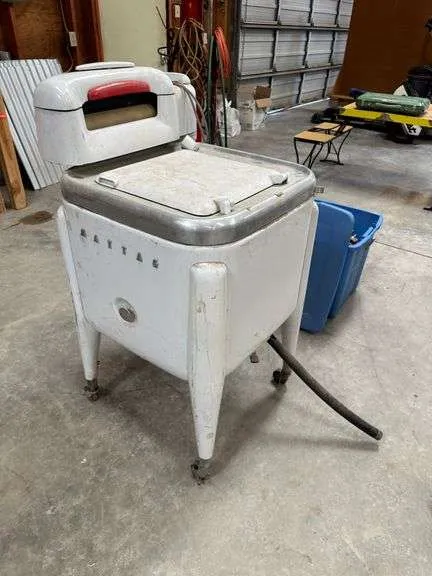
Photo: vintage 1950s Maytag washing machine American home laundry, via d3j17a2r8lnfte.cloudfront.net
Somewhere in America right now, there is almost certainly a Maytag wringer washer from the 1940s still doing laundry. Not in a museum. In a basement. Owned by someone's grandmother who has never once called a repair technician, never downloaded a troubleshooting app, and never received a notification that her appliance's software needed updating.
This is not a miracle. It was the standard.
For the better part of three decades — roughly from the late 1940s through the mid-1970s — American-made home appliances were built with a quiet, almost stubborn expectation of longevity. A refrigerator was supposed to last thirty years. A range, longer. A washing machine was a capital purchase, something you bought once, maybe twice in a lifetime, and maintained the way you'd maintain a good car: oil it, clean it, fix what breaks, keep going.
That world is gone. And what replaced it is costing American households a fortune.
What a 1957 Washer Actually Cost — And What It Was Worth
In 1957, a top-of-the-line Maytag washing machine retailed for around $300. Adjusted for inflation, that's roughly $3,200 in today's dollars. That sounds like a lot — until you divide it by the machine's lifespan.
Maytag's commercial-grade residential washers from that era routinely ran for 30 to 40 years with minimal maintenance. Do the math: $3,200 spread over 35 years works out to about $91 per year, or roughly $7.50 a month. For a machine that washed every piece of clothing your family owned, every week, without complaint.
Now consider the modern equivalent. A mid-range washing machine today costs between $600 and $1,200. Consumer Reports and appliance industry data consistently put the average lifespan of a modern washer at 10 to 13 years — and that assumes nothing major goes wrong. A single control board failure on a newer electronic model can cost $300 to $500 to repair, often more than the machine is worth at that point in its life. Most repair technicians will tell you, without hesitation: if it's more than seven years old and something significant breaks, buy a new one.
 Photo: Consumer Reports, via assets1.cbsnewsstatic.com
That advice, repeated millions of times a year across America, is itself a business model.
How We Got From There to Here
The decline of appliance durability didn't happen overnight, and it wasn't entirely the result of corporate cynicism — though that played a role. Several forces converged over several decades to move American manufacturing away from the build-it-to-last philosophy.
The first was cost competition. As the 1970s and 80s brought foreign manufacturing into the consumer goods market, American companies faced pressure to reduce prices. One reliable way to lower the cost of a washing machine is to use cheaper components — thinner steel, simpler motors, lower-grade plastics. Consumers, increasingly price-sensitive, often chose the cheaper option without fully accounting for the long-term cost.
The second was complexity. Older machines were mechanical: motors, belts, pumps, agitators. A competent home handyman — or a neighborhood appliance repairman — could diagnose and fix most problems with a wrench and a replacement part. Modern appliances run on circuit boards, digital sensors, and proprietary software. They're not designed to be repaired by individuals. In many cases, the manufacturer's service manual isn't even publicly available. You need a certified technician with a diagnostic tool that costs more than the machine itself.
The third force — and the most deliberately engineered — is what the industry calls the product replacement cycle. Manufacturers discovered, particularly from the 1980s onward, that a customer who replaces an appliance every ten years is worth more than a customer who buys once and disappears for forty. Extended warranties, service contracts, and the deliberate unavailability of replacement parts after a certain model year all serve the same function: they make repair uneconomical and replacement inevitable.
The Real Cost of Throwaway Appliances
Americans replace approximately 40 million major appliances per year. That number includes washers, dryers, refrigerators, dishwashers, and ranges. The majority of those replacements aren't driven by desire for something better — they're driven by failure.
The financial impact on individual households is significant. A family that replaces a washer and dryer every ten years will spend, over a forty-year period, three to four times what their grandparents spent on the same function — even accounting for inflation. And that doesn't include the service calls, the extended warranties they bought hoping to avoid exactly the expense they ultimately faced anyway, or the afternoons lost waiting for a technician who shows up with a tablet and a parts quote that makes no economic sense.
Then there's the environmental math. A 40-year appliance generates a fraction of the manufacturing waste, shipping emissions, and landfill burden of four ten-year appliances. The old Maytag sitting in someone's basement didn't just save its owner money. It was, by almost any measure, the more sustainable choice.
Something Was Built Into Those Old Machines That Isn't Made Anymore
It's tempting to romanticize the postwar appliance era, and it's worth being honest: those old machines weren't perfect. They were often less efficient with water and energy. They didn't have the features modern consumers expect. And they were heavy — genuinely, absurdly heavy — in a way that reflected the sheer amount of metal inside them.
But they were built by people who understood that a washing machine was a serious purchase for a working family, and that failing that family in year eight was a reputational catastrophe. Maytag's whole advertising identity for decades was built on the image of a repairman with nothing to do. That wasn't just a slogan. It was a manufacturing philosophy.
Somewhere along the way, the incentives flipped. The repairman with nothing to do became a liability. The repairman who shows up every seven years became the business plan.
And the machine in your laundry room? It's already on the clock.