The Milkman Knew Your Family Better Than Your Neighbors Did — And Then We Traded Him for an Algorithm
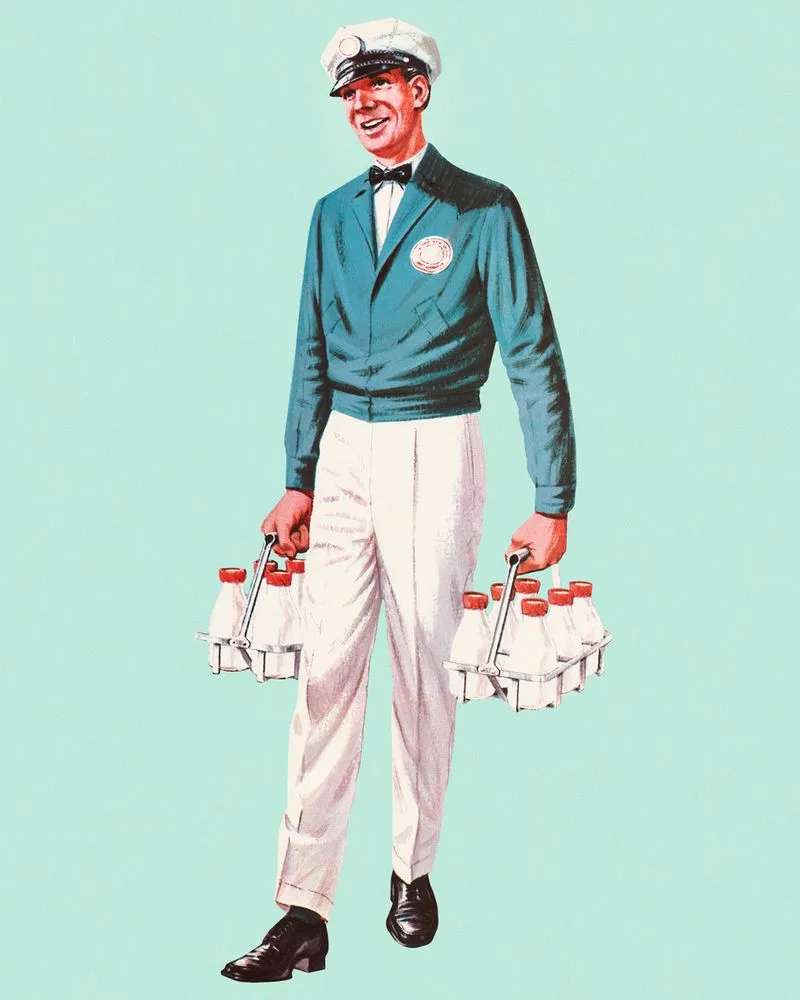
Photo: 1950s milkman delivering milk bottles suburban neighborhood doorstep, via backintimetoday.com
It was usually before sunrise. The sound of glass bottles on a metal carrier, the soft crunch of footsteps on a porch, and then — nothing. By the time most families came downstairs for breakfast, the milk was already cold on the stoop, the empties had been collected, and the milkman was three blocks away doing it all again.
For most Americans born before 1960, this was simply the texture of morning. Not remarkable. Not sentimental. Just how things worked.
But here's what that quiet, pre-dawn routine actually represented: a human being who knew you. Knew how many kids you had, roughly how much they drank, whether you'd started buying orange juice, whether you'd cut back on butter. A person who noticed — without being asked, without being paid to notice — when the bottles sat uncollected on a Tuesday morning when they should have been empty by Sunday night.
That person was, in ways that nobody fully appreciated at the time, one of the most important figures in the neighborhood.
The Route Was a Map of Ordinary Life
At the peak of home milk delivery in the United States — roughly the late 1940s through the early 1960s — an estimated 30 to 40 percent of American households received milk at their doorstep. In dense urban and suburban areas, that number was often higher. A single milkman might serve 200 to 400 households on a regular route, visiting each address multiple times a week.
The route was intimate by necessity. Drivers kept handwritten ledgers — or, later, simple order cards — tracking each customer's preferences. Two quarts of whole, one pint of cream, butter on Thursdays. They knew which houses had new babies (sudden jump in orders), which had teenagers (everything doubled), and which had recently lost someone (orders that quietly shrank and then stopped).
Icemen worked the same way, as did bread delivery drivers and the occasional egg man. These weren't just logistics workers. They were, functionally, a distributed network of neighborhood observers — people whose jobs required them to pay close attention to patterns, and whose humanity meant they sometimes acted on what they saw.
There are documented cases — reported in local newspapers throughout the 1950s and 60s — of milkmen alerting families or authorities when elderly customers hadn't collected their bottles for two or three days. In more than a few instances, that call saved a life. The person on the other end of the door was having a medical emergency, or had fallen, or was simply too ill to reach the porch. The milkman, making his rounds at 5am, was the only person in a position to notice.
No app does that. No algorithm is designed to.
Why the Routes Disappeared
Home milk delivery didn't vanish because Americans stopped wanting it. It disappeared because supermarkets made milk cheaper, and cheaper won.
Through the 1950s, the expansion of grocery chains and refrigerated transport allowed stores to sell milk at prices that home delivery simply couldn't match. The milkman's price included a truck, a driver, a route, a dairy relationship, and the overhead of individual delivery. The supermarket's price included none of that personalization — just volume and efficiency.
By the mid-1970s, home milk delivery had fallen to under 10 percent of American households. By the 1990s, it had essentially vanished from most of the country, surviving only in a handful of regional dairies serving nostalgic or specialty markets. The iceman had gone decades earlier, replaced first by electric refrigerators and then by ice makers built into the refrigerators themselves. The bread man followed a similar arc.
Each disappearance was, on its own terms, rational. Cheaper, faster, more convenient. The math always made sense.
But the math never accounted for what the route was actually doing.
What the Route Was Actually Doing
Social scientists have a term for the kind of low-intensity, repeated human contact that builds community cohesion: they call it "weak ties." The milkman wasn't your friend. He probably wasn't even someone you'd recognize at the grocery store in street clothes. But he was a consistent, reliable human presence in your daily life — someone who acknowledged your existence, remembered your preferences, and maintained a kind of ambient awareness of your household's rhythms.
Weak ties, research consistently shows, are enormously important to individual wellbeing and community resilience. They're the reason people feel more connected in neighborhoods with front porches, walkable streets, and local shops where someone knows your usual order. And they're exactly what's been systematically stripped out of modern American daily life in the name of efficiency.
Today's delivery economy is, in many ways, the logical endpoint of the supermarket revolution that ended the milkman's era. Amazon, Instacart, DoorDash — these platforms are extraordinary feats of logistics. They are also, by design, anonymous. The driver who leaves your groceries on the porch doesn't know your name. The algorithm that predicted you'd want laundry detergent this week knows more about your purchasing behavior than any milkman ever did — and cares about it in an entirely different way. It cares about it as data. As a conversion opportunity. Not as a person.
Nobody at a fulfillment center is going to notice that your order stopped. Nobody is going to call.
The Thing Efficiency Can't Deliver
This isn't an argument for going back. Home milk delivery wasn't perfect — it was labor-intensive, expensive relative to alternatives, and dependent on a workforce that had other options as the economy expanded. The supermarket gave American families real savings and real convenience, and those things mattered.
But it's worth sitting with what was quietly traded away. A country that once had hundreds of thousands of people whose jobs required them to pay human attention to individual households — to notice, to remember, to occasionally act — replaced all of that with a system optimized to move products without friction.
The friction, it turns out, was the relationship. And we didn't realize we'd miss it until it was already gone.
Somewhere in the past, a milkman is lifting a crate of bottles off a porch in the dark, noting that the widow on the corner has cut her order again, and making a mental note to check on her Thursday. Nobody asked him to. Nobody tracked it. Nobody measured the outcome.
He just knew her. And that was enough.