Eight Weeks in the Woods Used to Cost Less Than a Tank of Gas — What Happened to Summer Camp?

There's a photograph that exists in probably ten million American attics. A kid in a canoe, squinting at the sun, paddle raised, grinning like nothing in the world could touch them. Behind them, a pine-covered shoreline. Somewhere off-camera, a counselor is blowing a whistle. It is, unmistakably, summer camp — and for most of the twentieth century, it was just what middle-class American kids did in July.
Not the lucky kids. Not the rich kids. Just... kids.
Today, that same experience — two or three weeks at a residential camp with a lake, a mess hall, and a ropes course — will set a family back anywhere from $3,000 to $8,000. Some specialty programs, the ones promising early coding skills or elite athletic training, charge north of $10,000 for a single session. The canoe is still there. The price tag is unrecognizable.
What Camp Actually Cost Back Then
In the 1950s and early 1960s, a four-week stay at a traditional residential summer camp ran roughly $100 to $200. Adjusted for inflation, that's somewhere in the range of $1,000 to $1,800 in today's dollars — for an entire month away from home. Many camps charged even less, particularly those affiliated with churches, the YMCA, or civic organizations like the Boy Scouts, where fees were kept deliberately accessible.
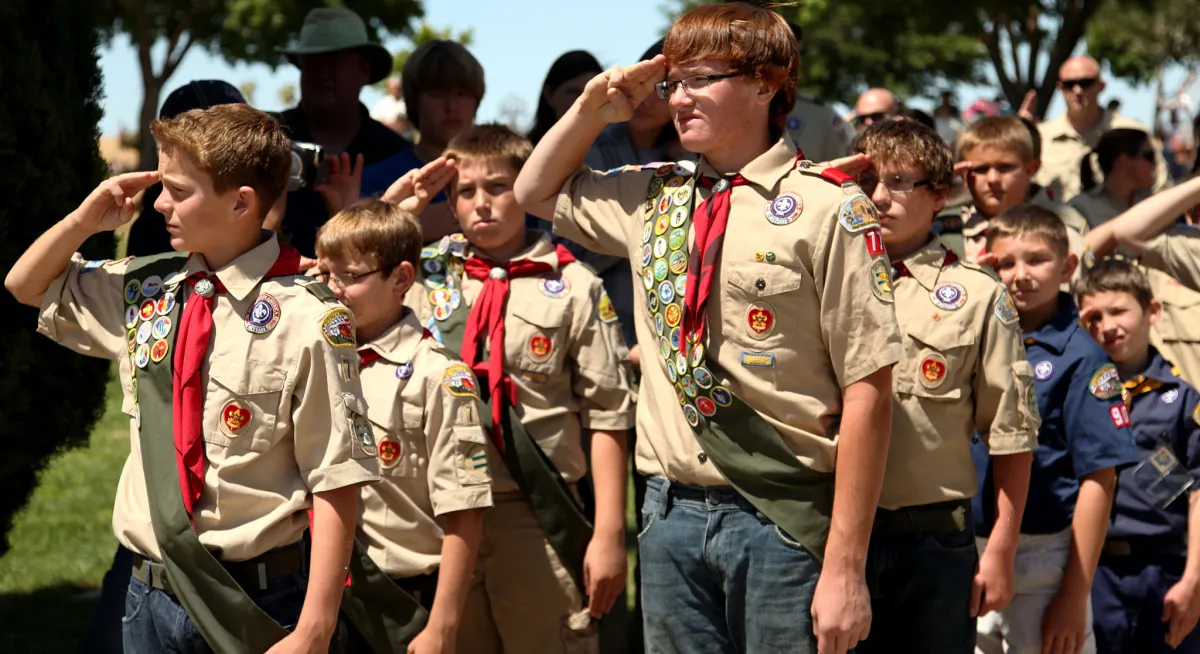 Photo: Boy Scouts, via campbelllawobserver.com
For a working-class or middle-class family, it was a real expense — not trivial — but it was manageable. Parents planned for it, saved a little through the winter, and sent their kids off with a trunk full of labeled t-shirts and a sense that this was simply part of growing up American.
The camp itself was usually rustic by design. Wooden cabins with screens instead of windows. Cold-water showers. Communal dining. The activities were simple: swimming, archery, hiking, crafts, campfire songs. Nobody was building a college application. Nobody was developing a personal brand. Kids were just learning to be away from home, make friends with strangers, and figure out who they were when their parents weren't watching.
The Infrastructure Was Cheaper Because the World Was Different
Several forces converged to make mid-century camp affordable in ways that simply can't be replicated today.
Land was cheap. Many camps sat on dozens or even hundreds of acres of rural property purchased for almost nothing in the 1930s and 40s. That land is now worth millions. Camps that once owned their grounds outright have sold them to developers, been priced out of their leases, or struggle to pay property taxes on real estate that's become valuable precisely because fewer people want to live rurally anymore.
Staffing was different, too. College students worked as counselors for the summer in exchange for room, board, and a modest stipend — sometimes as little as a few hundred dollars for the entire season. It was considered a formative experience, not a career. Today, camps must compete for staff, meet minimum wage requirements, and in many states comply with specific staff-to-camper ratios that didn't exist fifty years ago.
And then there's liability. The transformation of American legal culture through the 1970s and 80s changed how every institution operated. Camps that once let kids climb trees unsupervised or canoe without a certified lifeguard on every dock now carry insurance policies that cost more per year than some of those original camps paid for their entire property. Waivers, background checks, first aid certifications, allergen protocols — all necessary, all expensive, all non-existent in 1962.
What Replaced the Old Camp Economy
For families who can't afford $4,000 a month, the alternative is usually day programs — structured activities that run from 9am to 3pm and cost, on average, $300 to $500 a week. That's not nothing. A full summer of day camp easily runs $3,000 to $5,000, often more in urban areas. And unlike the residential experience, the kid comes home every night, which means working parents still need to manage the gap hours.
Meanwhile, the high-end camp market has exploded into something the founders of those old pine-and-canvas operations would barely recognize. There are camps today that specialize in film production, neuroscience, fashion design, robotics, and competitive debate. They market themselves not as places to grow up, but as investments in future achievement. The brochures read less like summer adventure and more like a prep school admissions pitch.
Nothing against any of that. But it does represent a fundamental shift in what camp is for. The old model assumed that unstructured time in nature, away from parents, with a mixed group of strangers was inherently valuable. The new model tends to assume that every childhood hour needs to be productive.
The Thing That Actually Got Lost
Here's what's easy to miss in the cost comparison: the old summer camp wasn't just cheap. It was equalizing. A kid from a modest family in Cleveland could spend July with kids from Chicago and Pittsburgh and rural Ohio, all of them eating the same food, sleeping in the same cabins, navigating the same social dynamics. It was one of the few genuinely mixed-income experiences American childhood offered.
Today's camp landscape is increasingly stratified. The families who can afford the premium programs send their kids there. Everyone else patches together whatever they can. The result is that a shared cultural experience — one that showed up in movies, books, and the memories of virtually every American adult for decades — has quietly sorted itself by zip code.
The canoe is still there. The lake is still beautiful. But not everyone gets to paddle anymore.