The Recipe Box on the Counter Knew More About Feeding a Family Than Any App Ever Will
There's a good chance your grandmother owned a small metal or wooden box — nothing fancy, maybe painted, maybe just worn smooth at the edges — that sat somewhere near the stove or on the kitchen counter. Inside it: a stack of index cards, some splattered with grease, some written in handwriting you'd recognize anywhere, some in handwriting that belonged to women you never met but whose cooking you somehow know by heart.
That box was a technology. Not the kind with a screen or a subscription fee, but a technology nonetheless — a system for storing, transmitting, and building on practical knowledge across generations. And when we stopped using it, we lost more than just recipes.
Cooking Was Something You Absorbed, Not Streamed
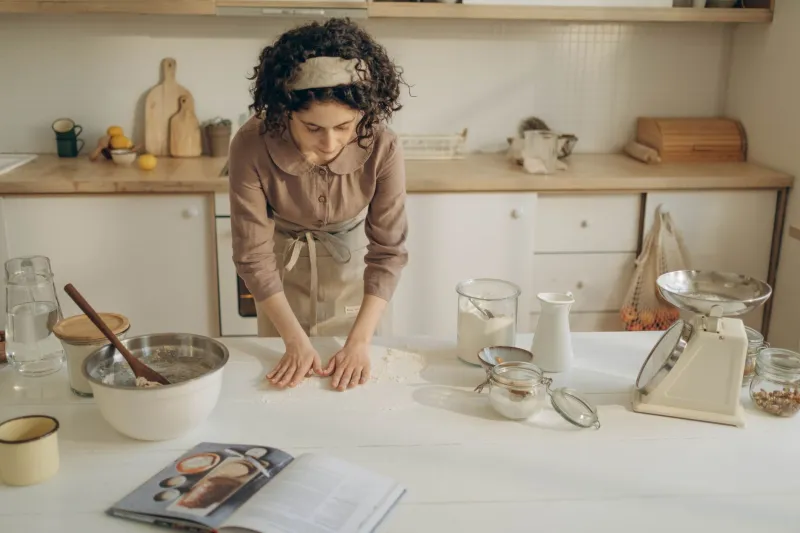
For most of American history, cooking wasn't a skill you learned from a show or a platform. You learned it by standing next to someone who already knew how to do it. You watched your mother brown butter without burning it, and you understood by instinct — not instruction — when the color was right. You learned your grandmother's pie crust by feel, because she never measured the shortening. She just knew.
This kind of knowledge transfer is called tacit knowledge — the kind that lives in hands and eyes and years of practice rather than in written instructions. The handwritten recipe card was the artifact that surrounded that knowledge, not the knowledge itself. "A pinch of salt" meant something specific when the person writing it had been cooking for forty years. It was a prompt, not a prescription.
Families built entire culinary identities this way. A Thanksgiving table in rural Ohio in 1965 reflected three or four generations of accumulated judgment — what worked, what didn't, what got refined over decades of Sunday dinners and church potlucks and feeding farmhands in August. Nobody needed to look anything up. The knowledge was already in the room.
The Index Card as Heirloom
There's something worth sitting with here: handwritten recipe cards are among the most emotionally powerful objects people inherit. More than jewelry, more than furniture, more often than not — a mother's handwriting on a stained index card for her cornbread dressing is the thing that makes adult children cry at estate sales.
That's not sentiment for its own sake. It reflects the fact that cooking knowledge was deeply personal, carried real identity, and was transmitted through genuine relationship. The recipe card was evidence of a living tradition — proof that someone cared enough to write it down so that you wouldn't have to figure it out from scratch.
The church cookbook — that spiral-bound collection assembled by the women of First Methodist or St. Anthony's — served the same function at a community level. It preserved local culinary culture in a form that was accessible, affordable, and specific to a place and a people. Those books are now collectibles. The tradition that produced them is essentially extinct.
What We Replaced It With
Somewhere in the 1990s and accelerating sharply through the 2000s, the American relationship with cooking began to shift. Cooking shows multiplied. Food Network launched in 1993 and turned cooking into entertainment rather than instruction. Celebrity chefs replaced grandmothers as the primary culinary authority in American culture.
Then came the apps. Allrecipes, Food52, Yummly, and dozens of others offered millions of searchable recipes, user ratings, and step-by-step instructions optimized for people who had never learned to cook from someone who knew how. The promise was democratization — anyone could make anything, regardless of background or experience.
And then came the meal kits. HelloFresh, Blue Apron, and their competitors took the logic one step further: not just the recipe, but the pre-measured ingredients, portioned and packaged, delivered to your door. You didn't need to know how to cook. You didn't need to know what mise en place meant or why you salt pasta water. You just needed to follow laminated instructions and own a pan.
The meal kit industry generated over $10 billion in annual revenue at its peak. It is, in the most literal sense, a business built on the absence of cooking knowledge — a subscription to the gap left behind when we stopped teaching people how to actually feed themselves.
The Confidence That Got Lost
The most significant casualty of this transition isn't any particular dish or technique. It's kitchen confidence — the ability to open a refrigerator, assess what's there, and produce a meal without consulting anything. That skill, which was once nearly universal among American adults, has become genuinely rare.
Surveys consistently show that younger Americans cook less frequently than any previous generation, rely more heavily on takeout and prepared food, and report higher levels of anxiety around cooking from scratch. A 2019 study found that nearly a third of Americans under 35 couldn't cook a simple meal without a recipe in front of them.
That's not a failure of intelligence or ambition. It's the predictable result of a culture that stopped transmitting cooking knowledge through relationship and started selling it back as content. When the knowledge stopped passing from person to person in kitchens, it didn't disappear — it got monetized.
What the Box Actually Contained
The recipe box on your grandmother's counter wasn't just full of recipes. It was full of confidence. The confidence that comes from having fed people, repeatedly and well, for decades. The confidence that knows a sauce can be fixed, that a cake that falls can become a trifle, that feeding twenty people from a single chicken is a logistics problem, not an impossibility.
That confidence is harder to download than a recipe. It doesn't arrive in a meal kit. No algorithm has figured out how to stream it.
The box is still out there, in attics and estate sales and the backs of kitchen drawers. The handwriting is still legible. It's not too late to read it.